Summary: Perinatal hypnosis training allows wellness professionals to specialize in pregnancy and childbirth support; a Cochrane review of 2,954 women confirms a reduced reliance on analgesics.
In France, mental health has been a Great National Cause since 2025, a focus extended into 2026 by the Government. Within this context, the perinatal period receives particular attention: funding allocated to perinatal policy reached €9.3 billion in 2021, a 9% increase compared to 2016. The demand for non-drug-based support is exploding, and perinatal hypnosis training is establishing itself as a high-growth specialization.
What is perinatal hypnosis and why seek training?
Perinatal hypnosis is a psychic well-being practice, complementary to traditional medicine, dedicated to childbirth preparation. It covers the entire journey, from the desire for pregnancy to postpartum, including the management of fears, nausea, and pain during labor.
Training in this discipline means acquiring a specific set of skills. Pregnancy profoundly modifies the relationship with the body, emotions, and pain. Research highlights a specific capacity of pregnant women: their high potential for hypnotizability.
For wellness professionals in France, this perinatal specialization meets a double opportunity: responding to a growing demand from future parents and structuring a differentiating support offer.
What scientific research says about the effectiveness of perinatal hypnosis
According to the Cochrane review, hypnosis can reduce the overall use of pain medication during labor. This meta-analysis covers nine randomized trials totaling 2,954 women. Women in the hypnosis group had a relative risk of 0.73 for using pharmacological analgesia compared to control groups.
On the French side, results show that hypnosis facilitates the regulation of stress and anxiety, and that its practice facilitates the management and acceptance of the painful phenomena of childbirth.
Inserm, in its 2015 expert report, confirms that certain studies have real methodological qualities and that there are enough elements to affirm that hypnosis has a potential therapeutic interest.
Key skills acquired during perinatal hypnosis training
- Therapeutic communication: Learning to adapt verbal and non-verbal language to the emotional specificities of pregnancy.
- Induction and self-hypnosis techniques: Mastering protocols adapted to each trimester, from managing nausea to support during labor.
- Pain and anxiety management: Using hypnoanalgesia to support contractions, the placement of an epidural, or a cesarean section.
- Postpartum support: Preventing and identifying baby blues, postpartum depression, and maternal-infant bonding disorders.
- Specific journeys: Supporting cases of ART (Assisted Reproductive Technology), perinatal grief, or high-risk pregnancies.
Studies show that self-hypnosis decreases labor time (particularly for first-time mothers), reduces the use of analgesics, and increases self-confidence and positive thoughts.
The body-emotion-spirit approach: a differentiating angle in perinatality
Most existing training programs focus on hypnotic techniques applied to obstetrics. However, the perinatal period involves much more than clinical know-how. Hypnosis is not merely a support technique against pain; it is a qualitative approach that engages the relationship with the body, history, and life markers of the woman being supported.
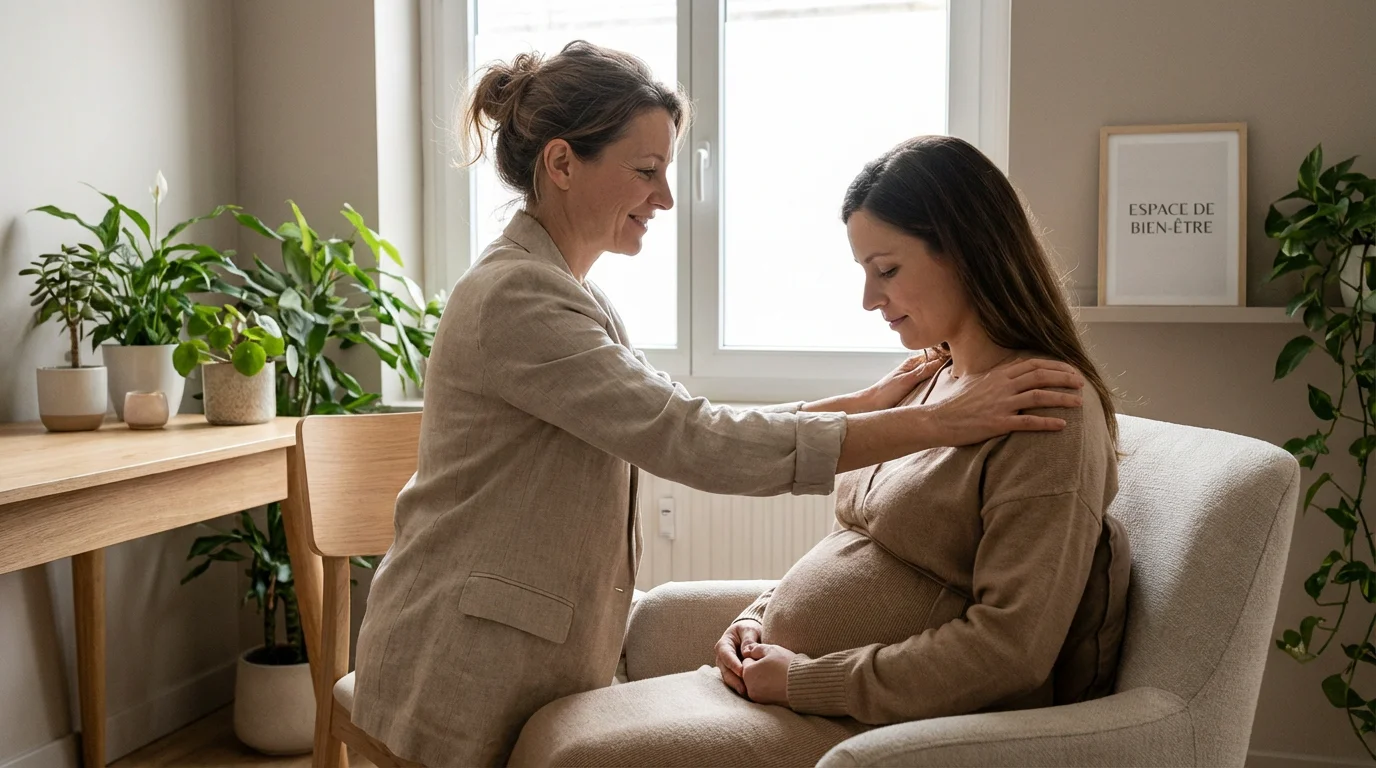
This integrated vision, which can be described as a body-emotion-spirit approach, is at the heart of our philosophy at Obienaitre. By combining physical techniques (massage, touch) with hypnosis and visualization tools, professionals create a unique support space.
Training Formats: In-Person, Online, or Hybrid?
Hypnosis training in France is diverse: there are about a dozen university programs as well as numerous associative and private trainings—some reserved for healthcare professions, others accessible to a broader audience.
The three main modalities are:
- Intensive In-Person: 2 to 10 days. Supervised practice, direct interaction. Travel and scheduling constraints.
- Asynchronous E-learning: 20 to 40 hours. Flexibility, self-paced progression. Lack of direct supervision.
- Hybrid (E-learning + Video/In-Person): Variable. Combines flexibility with personalized support. Requires strong self-organization.
Criteria for Choosing Quality Training
- Trainer Qualifications: Prioritize instructors with real clinical experience in perinatality (midwives, psychologists, specialized practitioners).
- Scientific Foundations: The training must be based on evidence-based data from research, such as Cochrane reviews or academic publications.
- Supervised Practice: Simulations, role-playing, and case analyses are indispensable for acquiring the correct professional stance.
- Certification and Recognition: Verify if the certification is recognized by wellness organizations and if it allows you to practice with confidence.
- Post-Training Follow-up: Continuous support (supervision, community, resources) guarantees a sustainable increase in skills.
Career Opportunities and Business Development
Specializing in perinatal support through hypnosis opens concrete perspectives. In France, 77.9% of first-time mothers follow birth preparation, a figure that is constantly increasing. This demand represents a pool of potential clients for trained practitioners.
Opportunities include individual support for expectant mothers, facilitating group birth preparation sessions, collaborating with maternity wards or midwifery practices, and creating online programs (self-hypnosis audio, guided visualizations).
Investment and Funding: What to Expect
The budget for perinatal hypnosis training varies significantly depending on the format and duration. Short specializations (2 to 3 days) range between €350 and €650. Long or integrated curricula represent a larger investment but generate a long-term return.
Several funding options exist: the skills development plan (for employees), funding through an OPCO, the training tax credit (for independent practitioners), or self-funding with staggered payments.
Frequently Asked Questions
Do I need to be a midwife to take a perinatal hypnosis course? No. These training programs are aimed at a wide audience: midwives, but also sophrologists, naturopaths, massage practitioners, psychologists, and career changers.
How long does perinatal hypnosis training take? The duration varies from 2 days (14 hours) for a short specialization to several weeks for a complete curriculum integrating supervised practice and entrepreneurial support.
Does perinatal hypnosis replace the epidural? No. Perinatal hypnosis is a complementary tool, not a substitute for medical analgesia. The Cochrane review notes a reduction in the use of pain medication, but results vary depending on the woman and the regularity of her practice.
