Summary: Acupressure training allows you to master an ancient Traditional Chinese Medicine technique that is in high demand; the wellness market in France exceeds €10 billion.
According to the WHO, Traditional, Complementary, and Integrative Medicine (TCIM) is used in 170 countries. In France, interest in natural practices continues to grow: the global wellness industry already exceeds $4 trillion, encompassing physical and mental health, alternative therapies, fitness, and nutrition. In this context, acupressure training is attracting more and more practitioners who wish to expand their skills and offer holistic support.
Professions focused on pressure-point massage such as acupressure are expected to experience employment growth faster than average. The rising popularity of Chinese massage therapy and the wellness boom in France are among the key factors driving this trend. Training in acupressure means acquiring a sought-after skill set based on ancient principles and opening up new professional opportunities.
What is acupressure and why train in it?
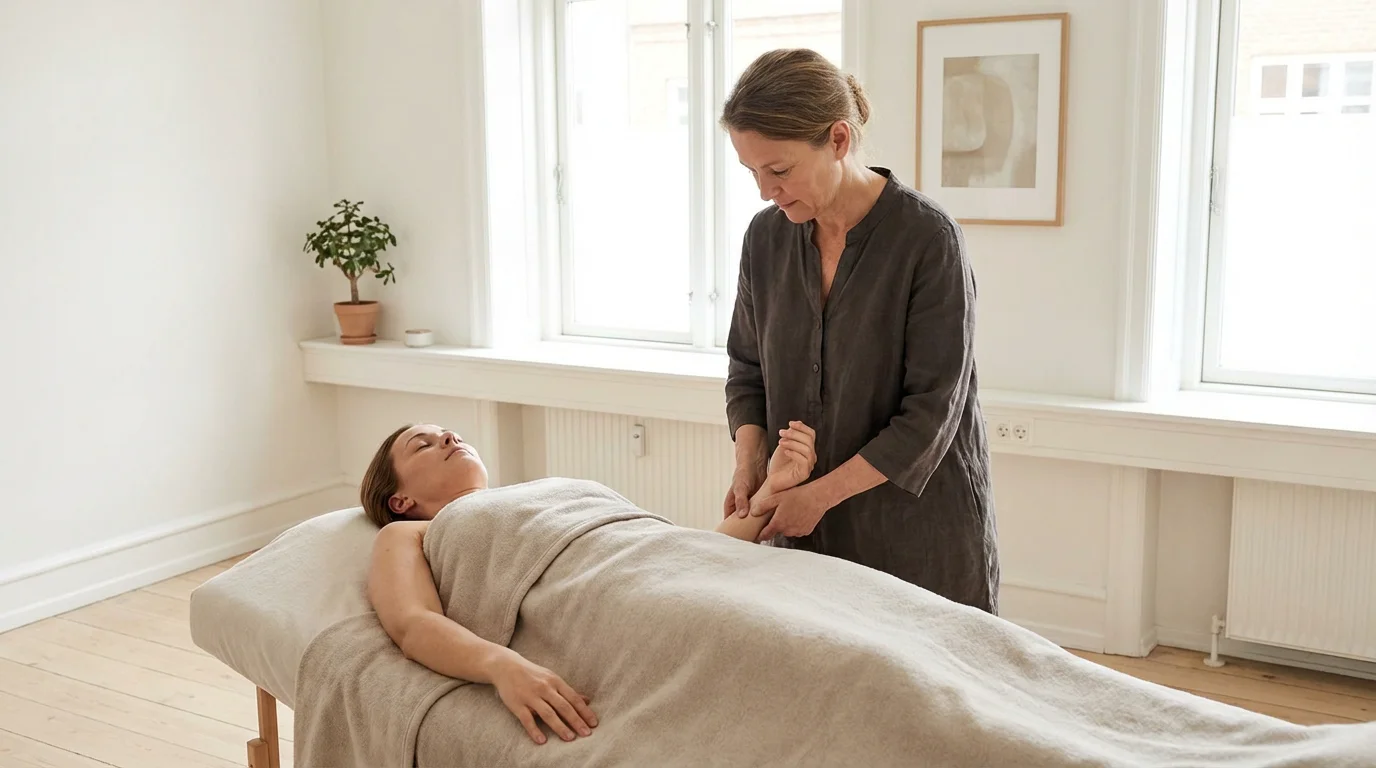
Acupressure is a traditional Chinese medicine technique that involves applying pressure to specific points on the body to relieve pain and improve overall health. Unlike acupuncture, it does not use needles. This non-invasive nature makes it an accessible approach for both practitioners and clients.
In practice, fingers, thumbs, and palms are used to apply pressure along energy meridians—channels through which Qi (vital energy) flows. The goal is to release blockages, improve blood circulation, and restore balance in the body. The WHO estimates that traditional medicine can be integrated into modern healthcare as a complement, particularly for managing side effects of certain treatments and improving overall well-being.
The WHO Global Traditional Medicine Strategy 2025–2034, launched in December 2025, further strengthens this trend. Nearly 90% of WHO member states (170 out of 194) report that 40–90% of their population uses traditional medicine. In other words, training in acupressure means responding to a growing and structured international demand.
The fundamentals taught in acupressure training
What does a digitopuncture or acupressure training program actually include?
Training programs vary in depth, but several core pillars are common to all serious courses.
Traditional Chinese Medicine theory: Yin and Yang, the Five Elements theory, and organ functions in TCM.
Meridian pathways: the 12 main meridians, as well as the Conception Vessel and Governing Vessel.
Acupressure point location and functions: progressive learning of key points and their indications.
Pressure techniques: tonification, sedation, and specific Tuina techniques.
Energetic assessment: observation, listening, palpation, and client questioning.
Protocols and contraindications: knowing when to apply treatment and when to refer to a healthcare professional.
TCM emphasizes a deep analysis of the patient's condition in order to select personalized points. In training programs of less than twenty days, this is absolutely not possible, as Traditional Chinese Medicine is a complex and profound discipline that requires real integration to be used effectively.
How to choose an acupressure training in France?
Duration and depth of the program
There is a wide range of acupressure training programs available online, some extremely short (sometimes only 2 or 3 days), while others are longer. If you are aiming for professional practice, it is not recommended to choose a very short course. For in-depth practice, aim for a minimum of 200 hours combining theory and practical training.
Certification and recognition
In France, there is no acupressure training offered at medical schools or physiotherapy schools. Training is provided by independent centers. Make sure the program issues a certification recognized by professional wellness organizations. Some courses are eligible for the CPF or can be funded by OPCOs.
Format: in-person, online, or hybrid
Acupressure is a hands-on discipline: practicing in pairs is essential. While some theoretical modules can be followed remotely, in-person practical training remains essential to develop proper technique and the sensitivity required.
Acupressure in support of fertility: a promising area of specialization
Among the applications of acupressure, fertility support is generating increasing interest. By stimulating acupressure points, it may help release energetic blockages and improve blood circulation, which can support fertility. In women, acupressure may help regulate hormones and improve blood flow to the reproductive organs.
Studies published on PubMed (Lim CE, Wong WS, 2010) have explored the link between acupressure point stimulation and polycystic ovary syndrome (PCOS), one of the leading causes of female infertility. Acupressure may help women with PCOS by reducing stress-related hormones, balancing sex hormones, and stimulating ovulation.
For practitioners who wish to position themselves in this niche, combining acupressure and fertility massage represents a differentiated offering. We also offer a fertility massage training program that integrates a body, emotional, and energetic approach, with proven protocols and recognized certification.
The wellness market in France: real opportunities
Why specialize now? The wellness market in France represents more than €10 billion in 2025. This market is experiencing an average annual growth of 6%. Manual and energy-based practices are becoming increasingly visible within it.
Far from being just a trend, this growing interest is the result of a broader societal shift. Rising stress levels and professional pressure are pushing people in France to seek relief and take better care of themselves. For wellness practitioners, specializing in acupressure or fertility massage represents an opportunity to stand out in a growing market.
From employment to self-employment: structuring your activity after training
Defining your positioning
Generalist or specialist? By targeting a niche (fertility, sports, perinatal care), you attract a qualified clientele willing to invest in tailored support. A premium offer positioned between €1,500 and €3,500 for a 3- to 6-month program is entirely feasible.
Surrounding yourself with support to progress
Isolation is a common pitfall for independent practitioners. Joining a peer community and benefiting from structured coaching accelerates skill development.
Complying with the legal framework
Practices not recognized by the French national health insurance system are not covered. In France, complementary therapies such as osteopathy, naturopathy, or sophrology are not recognized. Acupressure falls into this category. However, some private health insurance plans partially cover these practices through a complementary medicine allowance.
Conclusion
Acupressure training opens the door to a practice based on thousands of years of knowledge, within a wellness market in France that exceeds €10 billion and shows annual growth of 6%. Choosing a comprehensive, certified, and sufficiently long program is essential to practice with competence and confidence.
Frequently Asked Questions
Do you need a medical diploma to practice acupressure in France?
No. Acupressure does not require a medical diploma. It is practiced within the field of wellness, provided that no medical diagnosis is made and no claim is made to cure any condition. A recognized professional certification is still strongly recommended in order to practice with full legitimacy.
How long does a serious acupressure training last?
Short courses of 2 to 4 days provide an introduction, but are not sufficient for professional practice. A complete program generally includes between 200 and 300 hours, combining theory and practical training.
Can acupressure be combined with fertility massage in your practice?
Absolutely. Acupressure is a natural complement to fertility massage, as it targets energy points linked to the reproductive system.
